Application maintenance and support that keeps products stable after launch
CogniCrew handles monitoring, bug fixes, dependency updates, and small enhancements so your live applications stay reliable while your team focuses on roadmap work.
Service overview
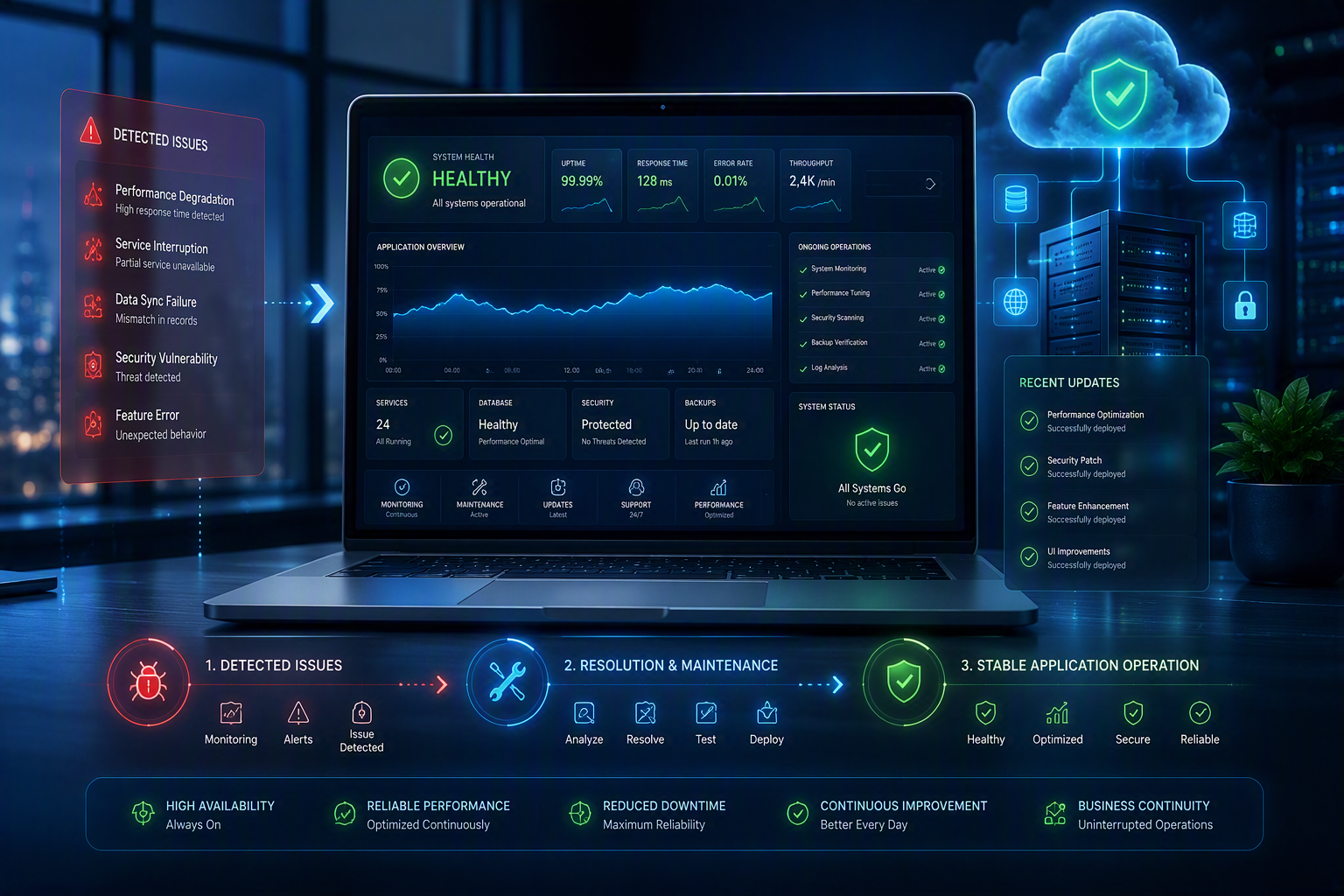
Launch is not the finish line. Production applications need ownership for incidents, updates, performance, and continuous improvement.
Our application maintenance and support services give you clear post-launch ownership: triage, bug fixing, monitoring, security and dependency updates, and SLA-based retainers matched to your operational needs.
We can maintain products we built or take over support for existing applications after an onboarding review of architecture, risks, and priorities.
Problems this service solves
Post-launch gaps that create downtime, backlog, and operational stress.
What we deliver
Practical outcomes designed to support growth, quality, and long-term product health.
Application maintenance and support capabilities
We keep live products healthy with operational ownership and continuous improvement capacity.
Respond to production issues with clear severity handling, communication, and resolution ownership.
Resolve defects and ship focused improvements without diverting your core product team.
Watch application health, catch issues earlier, and keep operational visibility on critical systems.
Keep packages, patches, and runtime versions current to reduce security and compatibility risk.
Investigate slow paths, stabilize resource usage, and improve responsiveness for active users.
Define response windows, reporting cadence, and support scope that match your operational needs.
Where maintenance and support create value
Ongoing ownership models that keep products stable while internal teams focus on growth.
Give a newly launched application clear support coverage for bugs, updates, and monitoring.
Hand over an existing production system after onboarding so your team can reclaim roadmap capacity.
Support the new stack after technology migration with incident handling and performance tuning.
Combine bug fixes and updates with a defined capacity for small enhancements each month.
Companies that need reliable production ownership without expanding ops overhead.
Engagement model
SLA-based monthly retainer
Onboarding
Architecture and risk review first
Primary focus
Stability, updates, and continuous improvement
Best paired with
Software testing & QA
Most clients use a monthly retainer with triage, bug fixes, updates, and planned improvement windows. Severity levels and response expectations are defined during onboarding.
We can also combine maintenance with QA support so release quality and production stability improve together across the delivery lifecycle.
Add software testing and QAHow we support live applications
Stabilize first, then improve continuously with clear priorities and reporting.
Onboard and assess
Review architecture, monitoring, known issues, and support priorities for the live product.
Define SLA and backlog
Agree response expectations, severity rules, and a maintenance backlog up front.
Support and improve
Handle incidents, updates, and enhancements on a steady cadence with clear communication.
Review and report
Share what was fixed, what improved, and what should be prioritized next.
Why choose CogniCrew for application maintenance
We provide practical production ownership with transparent communication and measurable support outcomes.
Incidents, bugs, and updates have defined handling instead of falling between teams.
Your product team stays focused on growth while maintenance work is handled separately.
Dependency updates, monitoring, and performance tuning are part of the retainer rhythm.
Retainers can include room for small enhancements that keep the product moving between major releases.
Services that pair with maintenance support
Frequently asked questions
Detailed answers to help you evaluate fit, scope, timeline, and delivery model.
Is this different from managed IT services?
Yes. Application maintenance focuses on your product codebase and production app health. Managed IT services covers broader IT operations and infrastructure support.
Can you maintain apps you did not originally build?
Yes. We start with an onboarding review to understand architecture, risks, and the highest-value support work.
Do retainers include small feature work?
Often yes. Many retainers balance bug fixes and updates with a defined capacity for small enhancements.
What response times can you support?
SLA options depend on severity and engagement size. We define response and resolution expectations during onboarding.
How do you report maintenance progress?
Monthly reviews typically cover incidents handled, bugs fixed, updates applied, and recommended next priorities.
Can maintenance start right after launch?
Yes. Post-launch retainers are one of the most common ways teams keep ownership clear after go-live.
Ready for clearer ownership of your live product?
Tell us what is in production today and we will recommend a maintenance plan that keeps the application stable and improvable.