Technology migration services to move your product onto a modern stack
CogniCrew helps teams upgrade frameworks, languages, and architectures with phased delivery, clear cutover plans, and less disruption to active product work.
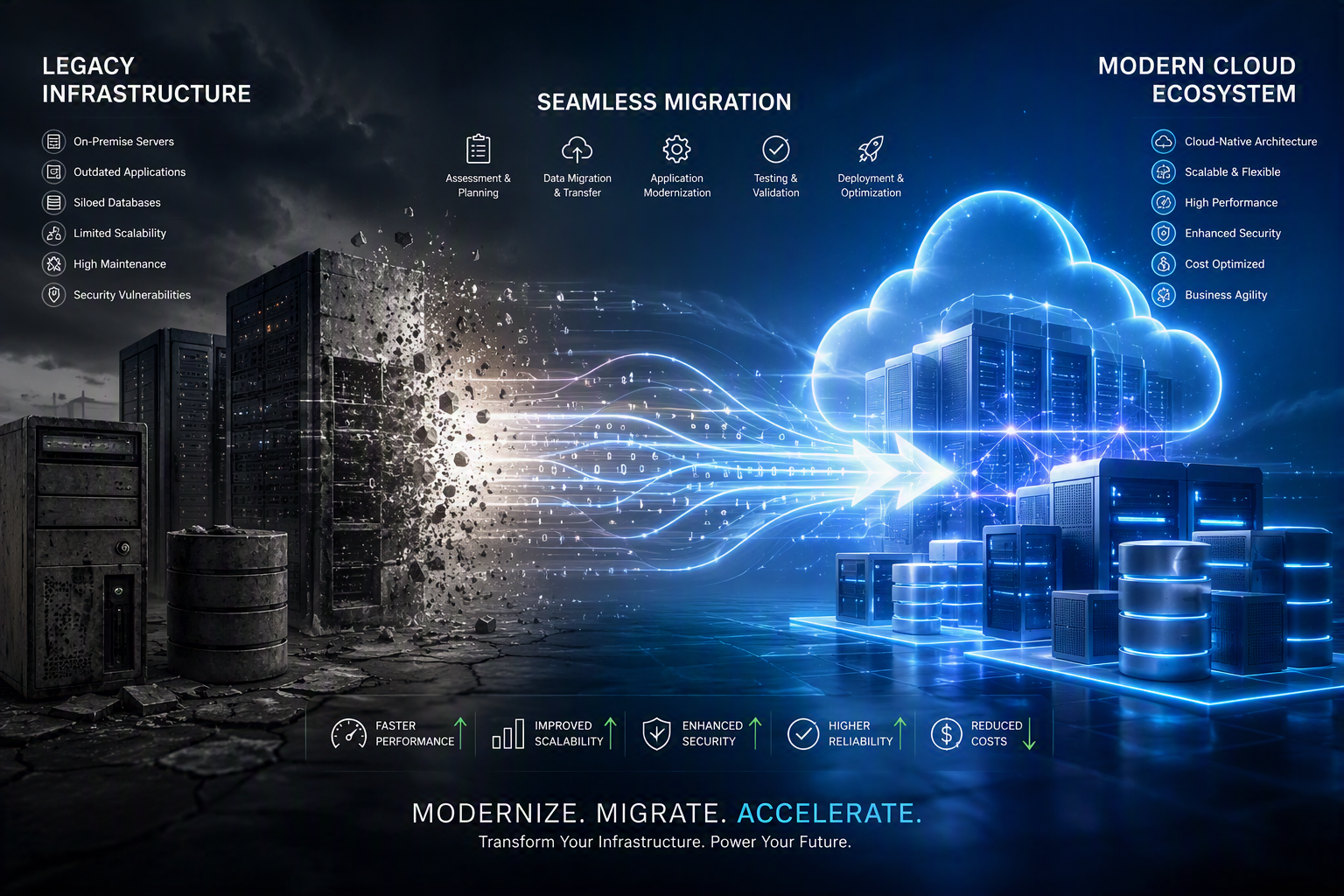
Service overview
Outdated stacks slow every release. Unsupported libraries, fragile builds, and aging architectures increase risk while making it harder to hire, secure, and scale the product.
Our technology migration services focus on controlled upgrades: framework and runtime moves, architecture modernization, dependency cleanup, and phased cutovers that protect business continuity.
This is different from broad legacy modernization. Technology migration is for teams that need to move a current product onto a maintainable modern stack without freezing feature delivery.
Problems this service solves
Stack and platform issues that quietly increase cost and delivery risk.
What we deliver
Practical outcomes designed to support growth, quality, and long-term product health.
Technology migration capabilities
We cover stack, data, delivery, and cutover planning so migration improves the platform without stopping the business.
Move from outdated frameworks and runtimes to current, maintainable stacks with deliberate compatibility planning.
Shift monoliths toward modular services or cleaner boundaries where that change improves speed and ownership.
Migrate schemas, APIs, and integrations carefully so connected systems keep working during transition.
Replace unsupported packages, patch known risks, and align environments with modern security baselines.
Update pipelines, environments, and release practices so the new stack can be shipped reliably.
Use incremental releases, feature flags, and rollback paths instead of risky all-at-once launches.
Common technology migration scenarios
Migration work that unlocks speed, security, and maintainability.
Move aging frontend stacks to modern frameworks while preserving product behavior and improving delivery speed.
Upgrade services, APIs, and data access patterns to current standards with staged validation.
Introduce cleaner boundaries so teams can ship independently without rewriting everything at once.
Reduce security risk and maintenance burden by cleaning unsupported packages and outdated infrastructure patterns.
Teams that need a modern platform without stopping product progress.
Engagement model
Assessment + phased migration program
Typical timeline
Depends on stack depth; often multi-phase
Primary focus
Lower risk, modern maintainable platform
Best paired with
QA, legacy modernisation, and DevOps support
We begin with a stack assessment and risk map, then define a phased migration plan by module, service, or customer journey. Dual-running and incremental cutovers are used where risk is high.
Legacy application modernisation can run in parallel when older systems need deeper replatforming beyond a straightforward stack upgrade. We help you choose the right path.
See legacy application modernisationHow we migrate technology stacks
Assess, plan, migrate in slices, and validate. Continuous progress with controlled risk.
Assess the current stack
Review architecture, dependencies, risks, and delivery pain points to define migration scope.
Define the target platform
Agree target frameworks, architecture boundaries, and success criteria before major moves begin.
Migrate in phases
Move modules or services incrementally with testing, monitoring, and rollback options.
Stabilize and hand off
Complete documentation, pipeline updates, and knowledge transfer for long-term ownership.
Why choose CogniCrew for technology migration
We treat migration as a delivery program with commercial continuity, not a speculative rewrite.
Phased plans, validation gates, and rollback options keep migration from becoming a big-bang event.
We design migrations that allow feature work to continue instead of freezing the roadmap.
Target platforms are chosen for maintainability and team fit, not trend-chasing.
Testing, CI/CD, and monitoring are part of the migration so the new stack stays shippable.
Services that support successful migrations
Deeper replatforming when systems need more than a stack upgrade.
ExploreProtect cutovers with regression coverage and release readiness checks.
ExploreStabilize the new platform after migration with ongoing support.
ExploreFrequently asked questions
Detailed answers to help you evaluate fit, scope, timeline, and delivery model.
How is this different from legacy application modernisation?
Technology migration focuses on upgrading your current stack and architecture. Legacy modernisation is broader and often includes deeper rewrites, UX refresh, and long-term technical debt reduction on older systems.
Can you migrate without stopping feature work?
Usually yes. Phased migrations and dual-running approaches help teams keep shipping while the platform improves underneath.
Which stacks do you typically migrate?
Common work includes frontend framework upgrades, Node and Python runtime moves, API redesigns, and shifts toward more modular or cloud-ready architectures.
How do you reduce migration risk?
We use staged cutovers, automated testing, monitoring, and rollback plans so issues can be contained quickly.
Do you start with an assessment?
Yes. Most engagements begin with a stack and risk assessment so the roadmap, effort, and sequencing are grounded in evidence.
What happens after the migration?
We hand off documentation and operating guidance, and can continue with QA or maintenance support to stabilize the new platform.
Ready to move onto a modern, maintainable stack?
Share your current stack and constraints and we will outline a practical migration path with lower delivery risk.