Software testing and QA services that protect release quality
CogniCrew strengthens release quality with structured QA coverage across functional testing, regression, automation, and release readiness so defects are caught before customers find them.
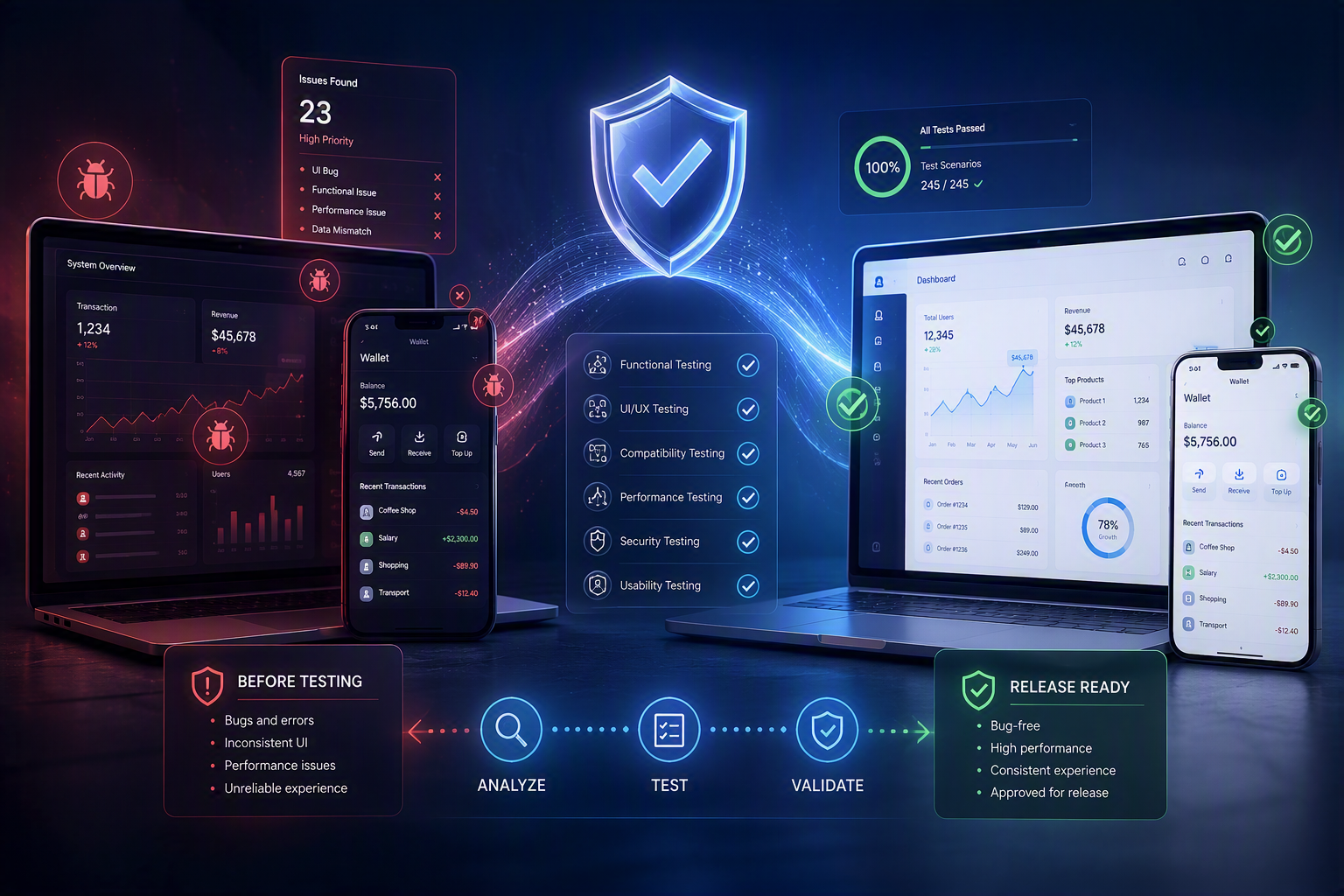
Service overview
Fast delivery only creates value when quality stays visible. Without clear test coverage, teams ship regressions, reopen old bugs, and lose confidence in every release.
Our software testing and QA services fit into your delivery rhythm. We define risk-based coverage, execute functional and regression testing, build automation where it pays off, and provide release readiness checks before go-live.
Whether you need embedded sprint QA, pre-launch hardening, or automation for critical journeys, we make quality measurable and actionable.
Problems this service solves
Quality gaps that create production incidents and slow delivery confidence.
What we deliver
Practical outcomes designed to support growth, quality, and long-term product health.
Software testing and QA capabilities
We provide the testing layers product teams need to ship frequently with confidence.
Define risk-based coverage so the most important flows and edge cases get attention first.
Validate features against requirements and protect existing journeys as new releases ship.
Make issues actionable with severity, reproduction steps, and clear ownership for fixes.
Build UI and API automation around high-value paths to reduce repetitive manual effort.
Identify bottlenecks and load risks before peak traffic or major launches.
Use structured exit criteria so go-live decisions are based on evidence, not guesswork.
Where QA creates the most value
Testing engagements that protect launches, migrations, and continuous delivery.
Add continuous testing inside your product cadence so quality keeps pace with feature delivery.
Run focused functional, regression, and readiness checks before a major product launch.
Protect stable journeys with automated UI and API suites that reduce manual regression load.
Verify behavior across old and new systems so technology migrations do not introduce silent regressions.
Teams that need stronger quality gates without slowing delivery.
Engagement model
Sprint QA, launch QA, or automation build
Typical start
Coverage plan within the first week
Primary focus
Defect prevention and release confidence
Best paired with
Technology migration and maintenance support
We typically embed with your sprint cycle, cover critical test paths each release, and expand automation where it pays off fastest.
For migrations and major launches, we can also run focused quality gates around cutover readiness, with clear go/no-go criteria.
Pair QA with application maintenanceHow we run software testing and QA
Plan coverage, execute against risk, automate the stable paths, and report clearly before release.
Understand product risk
Map critical journeys, known weak points, and release goals to prioritize testing effort.
Build the test plan
Define manual and automated coverage around the flows that matter most to users and revenue.
Execute and report
Triage findings with clear severity so engineering can fix the highest-impact issues first.
Automate and improve
Move stable regression paths into automation and expand coverage with each release cycle.
Why choose CogniCrew for software testing and QA
We make quality part of delivery, not a late-stage gate that blocks launch without clarity.
Testing effort focuses on journeys and defects that actually affect customers and revenue.
We work inside your sprint and release process instead of creating a disconnected testing silo.
Automation targets stable, high-value paths so maintenance cost stays justified.
Release readiness is evidence-based, with visible status for product and engineering leads.
Services that pair with strong QA
Validate stack upgrades and cutovers with structured regression coverage.
ExploreKeep production stable after release with ongoing support ownership.
ExploreBuild and test new product features with quality baked into delivery.
ExploreFrequently asked questions
Detailed answers to help you evaluate fit, scope, timeline, and delivery model.
Do you offer manual testing, automation, or both?
Both. Manual testing is useful for exploratory and new-feature coverage, while automation protects stable journeys across releases.
Can QA work inside our existing sprint process?
Yes. We commonly join the same planning and release cadence as your product and engineering teams.
What tools do you typically use?
Tooling depends on your stack, but common setups include API test frameworks, browser automation, and reporting that fits your issue tracker.
Is this useful during a technology migration?
Very. Migration projects benefit from regression coverage and release readiness checks that reduce cutover risk.
Can you start with a short QA assessment?
Yes. A short assessment can identify coverage gaps, high-risk journeys, and the fastest path to better release confidence.
How do you report quality status?
We provide clear defect summaries, coverage notes, and release readiness status so decisions are easy for product and engineering leads.
Ready to ship with stronger quality gates?
Tell us how you release today and we will recommend the right mix of manual QA, automation, and readiness checks.