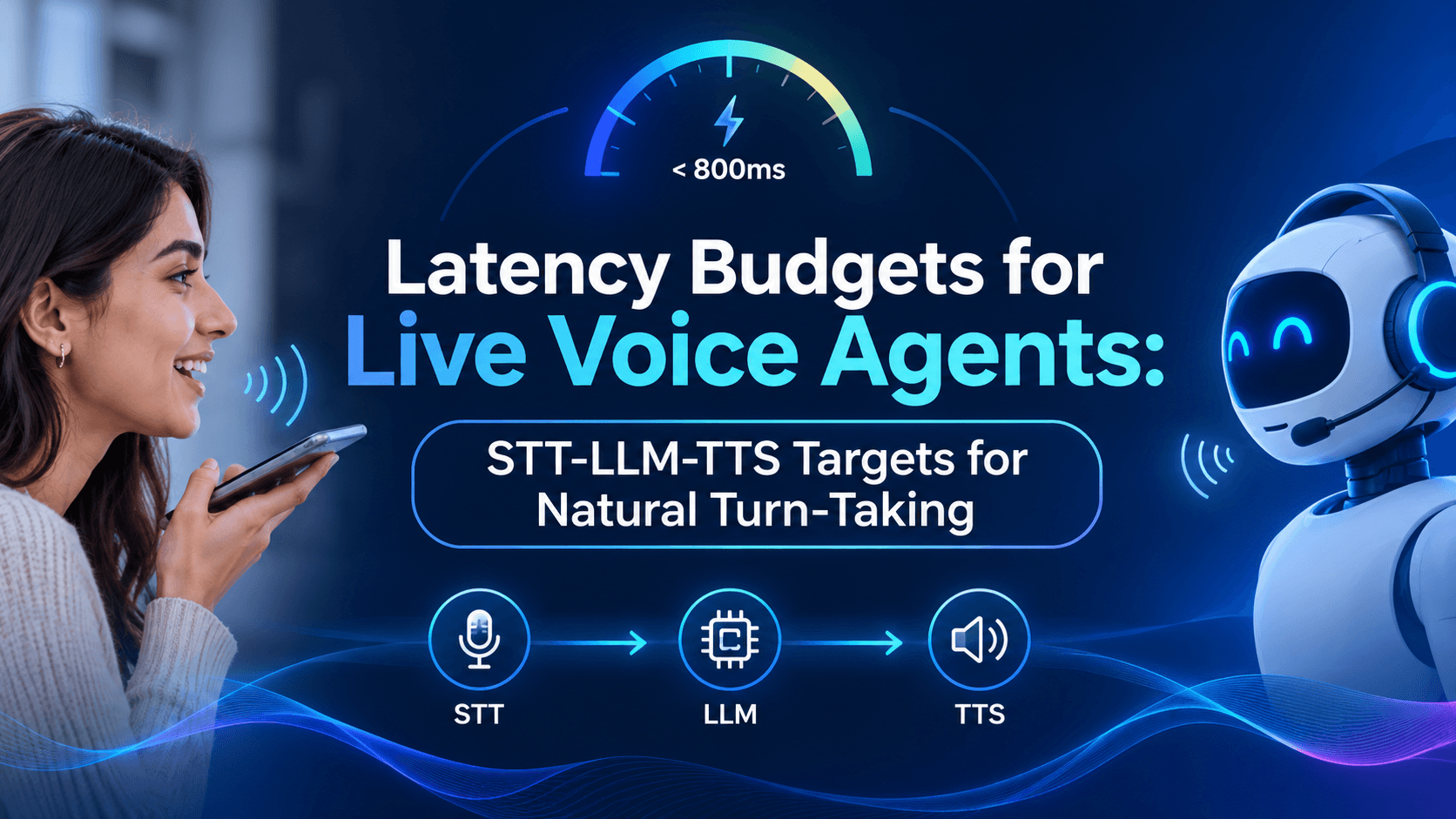
The Human Threshold: Why 800ms Breaks Conversational Flow
In live voice interactions, a delay of just 500 milliseconds can shatter the illusion of a natural conversation, making precise latency budgeting essential for enterprise-grade voice agents. To understand why this matters, we must first look at the psychological baseline of human dialogue.
Defining the Latency Budget
Human conversational turn-taking typically occurs within 200 to 300 milliseconds. This rapid exchange is a cognitive shortcut that signals active listening and engagement. When a system exceeds the 800-millisecond mark, users no longer perceive a pause; they perceive a failure. The agent appears broken, unresponsive, or simply out of the loop, leading to immediate user frustration and abandonment.
To prevent this, we define the latency budget as the total allowable time from the end of user speech to the start of the agent's audio response. This budget is not a single number but a strict constraint that governs the entire pipeline. It forces engineers to account for every millisecond spent in speech-to-text processing, large language model inference, and text-to-speech synthesis.
- Sub-300ms: Perceived as natural, human-like responsiveness.
- 300ms to 800ms: Noticeable lag that disrupts conversational flow.
- Over 800ms: Perceived as a system error or dead air.
By establishing this psychological and technical baseline, teams can prioritize architectural decisions that protect the user experience. Voice AI Agents that ignore these thresholds will fail to deliver the seamless interactions modern customers expect. Understanding this limit is the first step in designing a pipeline that feels alive rather than mechanical.
Deconstructing the Pipeline: STT, LLM, and TTS Latency Components
To achieve sub-second response times, engineering teams must allocate precise millisecond budgets to each stage of the voice agent pipeline. Speech-to-Text (STT) latency is primarily driven by audio buffering and model inference speed. Depending on streaming capabilities, this stage typically consumes 100-300ms. Minimizing buffer sizes and utilizing real-time streaming APIs are critical for keeping this component efficient.
Optimizing LLM Inference for Speed
The Large Language Model (LLM) is often the most variable component in the pipeline. Inference latency depends heavily on model size, context window length, and hardware acceleration. For a complete response generation, this stage typically requires 200-600ms. To reduce this, teams should consider:
- Quantizing models to reduce computational overhead
- Limiting context window size to only necessary conversation history
- Deploying models on high-throughput GPU clusters
Finally, Text-to-Speech (TTS) latency is influenced by synthesis speed and audio encoding. While not explicitly detailed in the initial key points, TTS must be optimized to begin audio generation as soon as the first tokens from the LLM are available, rather than waiting for the full response. By breaking down these three primary technical stages, CogniCrew AI Solutions can identify bottlenecks and fine-tune each component to ensure the total end-to-end latency remains within the natural conversational threshold. This granular approach to latency budgeting is essential for maintaining the illusion of a seamless, human-like interaction.
Architectural Strategies for Sub-Second Response Times
Achieving natural turn-taking requires moving beyond sequential processing. By overlapping pipeline stages, CogniCrew AI Solutions enables voice agents to respond with human-like immediacy. The core strategy involves decoupling the start of synthesis from the completion of generation.
Streaming and Speculative Decoding
The most effective method for reducing perceived wait times is implementing streaming for both Speech-to-Text (STT) and Text-to-Speech (TTS). Instead of waiting for a full sentence to be transcribed, streaming STT begins processing audio chunks in real-time. Similarly, TTS can start synthesizing audio as soon as the first few words are generated by the LLM. This overlap significantly reduces the time between the user's last word and the agent's first audible response.
- Streaming STT: Processes audio frames as they arrive, triggering early intent detection.
- Speculative Decoding: Uses a smaller, fine-tuned model to draft an initial response rapidly. A larger, more capable model then verifies or refines this draft in the background.
- Hybrid Model Routing: Simple queries are handled by lightweight models for speed, while complex reasoning tasks are routed to larger models, ensuring intelligence is not sacrificed for latency.
These techniques allow the system to maintain a low time-to-first-token (TTFT) while preserving the depth of reasoning required for complex customer service interactions. By prioritizing the initial audio output, the architecture creates the perception of instant responsiveness, which is critical for maintaining user trust and engagement in live voice channels.
Business Impact: Retention, Efficiency, and User Trust
Technical latency improvements directly translate into measurable business outcomes. When voice agents respond within human-perceptual thresholds, the interaction feels less like a machine transaction and more like a natural dialogue. This shift significantly influences how customers perceive the service and whether they choose to stay or leave.
Reducing Abandonment and Boosting Satisfaction
Lower latency is the primary driver for reducing call abandonment rates. In live voice scenarios, a delay of even 500 milliseconds can shatter the illusion of natural conversation, causing users to feel frustrated or ignored. By optimizing the STT-LLM-TTS pipeline for sub-second response times, enterprises can make interactions feel more efficient and responsive. This directly increases customer satisfaction scores, as users are more likely to complete their intended tasks without resorting to alternative channels or abandoning the call entirely.
Furthermore, optimized pipelines allow for higher concurrency on the same hardware infrastructure. When each conversation consumes less computational time due to reduced waiting periods, the system can handle more simultaneous sessions. This efficiency reduces infrastructure costs per conversation, allowing organizations to scale their voice AI capabilities without proportional increases in operational expenditure.
- Retention: Natural turn-taking keeps users engaged, lowering drop-off rates during critical moments.
- Efficiency: Faster processing cycles maximize hardware utilization, lowering cost-per-call.
- Trust: Responsive agents build confidence in the technology, encouraging repeat usage.
For organizations seeking to balance user experience with operational cost, precise latency budgeting is not just a technical detail—it is a strategic business lever. Voice AI Agents that prioritize speed create a seamless bridge between human-like interaction and scalable automation, ensuring that every millisecond saved contributes to both customer loyalty and bottom-line efficiency.
Real-World Use Cases: Customer Support and Field Services
In live voice interactions, a delay of just 500 milliseconds can shatter the illusion of a natural conversation, making precise latency budgeting essential for enterprise-grade voice agents. Let's look at how these targets apply in specific industry scenarios.
Customer Support: Handling Interruptions and Clarifications
In customer support, rapid turn-taking allows agents to handle interruptions and clarifications smoothly, mimicking human call center dynamics. When a caller asks a follow-up question, the system must quickly process the STT, query the LLM, and generate a TTS response before the caller loses patience. This is where Customer Service Conversational AI shines, ensuring that context is captured and resolved without awkward silences.
Field Services: Hands-Free, On-Site Querying
For field services, low-latency voice agents enable technicians to query systems hands-free while on-site, requiring immediate feedback to maintain workflow. A technician troubleshooting a network issue cannot wait for a slow response; they need instant access to diagnostic data. This is where Voice AI Agents prove their worth, providing real-time, unscripted conversations that keep the workflow moving.
| Use Case | Primary Latency Target | Key Benefit |
|---|---|---|
| Customer Support | < 800ms | Smooth interruption handling and natural clarifications |
| Field Services | < 600ms | Immediate hands-free feedback to maintain workflow |
Explore how CogniCrew AI Solutions optimizes voice agent pipelines for sub-second response times.
Challenges: Network Jitter, Model Variance, and Hardware Constraints
Maintaining strict latency budgets in production environments is complicated by unpredictable infrastructure variables. Network jitter and packet loss can introduce erratic delays that disrupt the conversational flow, while LLM inference times fluctuate based on prompt length and complexity. To address these practical obstacles, engineering teams must implement robust buffering strategies and dynamic budgeting mechanisms.
Managing Unpredictable Pipeline Variables
Edge computing deployment helps mitigate network instability by processing audio closer to the user. Additionally, fallback mechanisms are critical for high-load scenarios where model variance threatens to exceed the allocated time budget. The following table summarizes common latency challenges and their corresponding mitigation strategies:
| Challenge | Mitigation Strategy |
|---|---|
| Network Jitter | Adaptive buffering and edge node deployment |
| LLM Inference Variance | Dynamic prompt truncation and model routing |
| Hardware Constraints | GPU optimization and asynchronous processing |
By proactively managing these variables, CogniCrew AI Solutions ensures that voice agents maintain consistent performance even under adverse conditions. This approach prevents the degradation of user trust that occurs when response times become erratic.
How CogniCrew AI Solutions Optimizes Voice Agent Latency
For enterprise teams deploying voice AI agents, latency is not just a technical metric; it is the primary driver of user trust and conversational flow. CogniCrew AI Solutions addresses this by treating the entire speech-to-text, language model, and text-to-speech pipeline as a single, unified performance system rather than a series of isolated components.
Integrated Pipelines and Real-Time Tuning
Our approach begins with architectural integration. By coupling optimized STT and TTS engines with fine-tuned LLMs, we eliminate the cumulative delays that typically plague modular voice stacks. This tight integration ensures that the time from user speech end to agent speech start remains consistently below 800 milliseconds, preserving the natural rhythm of human dialogue.
- End-to-End Orchestration: We manage the handoff between audio processing and language generation to prevent buffer bloat.
- Model Optimization: Fine-tuned LLMs are selected for speed and context retention, reducing inference time without sacrificing accuracy.
Beyond initial deployment, CogniCrew AI Solutions provides a suite of real-time monitoring and tuning tools. These dashboards allow engineering teams to visualize latency distribution across every stage of the pipeline. By identifying specific bottlenecks—whether they stem from network jitter, model variance, or hardware constraints—enterprises can proactively resolve issues before they impact customer experience. This continuous optimization loop is critical for maintaining high performance in dynamic production environments, ensuring that your voice agent remains responsive and reliable at scale.
Key Takeaways and FAQs for Implementing Latency Budgets
Successful live voice agents require precise engineering discipline to maintain the illusion of human-like conversation. The following points summarize the core strategies for achieving sub-second response times.
- Establish a strict end-to-end latency budget, typically under 800ms, and allocate specific millisecond targets for each pipeline stage.
- Optimize STT by using streaming recognition to process audio chunks in real time rather than waiting for full utterance completion.
- Reduce LLM inference time through model quantization, speculative decoding, or routing simple queries to smaller, faster models.
- Minimize TTS latency by employing low-latency synthesis engines and pre-buffering audio segments to start playback immediately.
- Implement edge computing to reduce network round-trip times, especially for geographically distributed users.
By adhering to these targets, organizations can build voice experiences that feel responsive and natural, directly impacting user satisfaction and operational efficiency. For teams looking to implement these strategies, Voice AI Agents provide a robust foundation for handling complex conversational flows with minimal delay.
Ready to optimize your voice agent pipeline for sub-second response times? Contact CogniCrew AI Solutions to discuss how we can help you achieve natural turn-taking in your live interactions.
What is the ideal STT latency for streaming voice agents?
The ideal STT latency for streaming voice agents is typically under 150ms to 200ms from the end of speech to the final transcription. This target ensures that the system can begin processing the user's intent before they have fully finished speaking, creating a seamless conversational flow. Achieving this requires using streaming recognition APIs that process audio in small chunks rather than waiting for the entire utterance to complete. It also involves implementing endpoint detection algorithms that accurately identify when the user has stopped speaking. If STT latency exceeds 300ms, users may perceive the agent as slow or unresponsive, leading to frustration and potential abandonment of the conversation. Therefore, selecting a high-performance STT engine and optimizing its configuration is critical for maintaining natural turn-taking.
How does LLM model size impact inference time?
LLM model size directly impacts inference time, with larger models generally taking longer to generate responses due to increased computational requirements. A smaller model, such as one with 7 billion parameters, can often generate a response in 200ms to 400ms, while a larger model with 70 billion parameters may take 1 second or more. This difference is significant in live voice interactions, where delays over 500ms can break the conversational rhythm. To mitigate this, organizations can use model quantization to reduce the precision of model weights, which speeds up inference without significantly sacrificing quality. Additionally, speculative decoding can be employed, where a smaller draft model predicts tokens that are then verified by the larger model, further reducing latency. The choice of model size should balance accuracy needs with latency constraints, often favoring smaller models for simple tasks and larger models for complex reasoning.
What role does edge computing play in reducing voice agent latency?
Edge computing plays a crucial role in reducing voice agent latency by processing data closer to the user, thereby minimizing network round-trip times. In traditional cloud-based architectures, audio data must travel to a central data center, be processed, and then sent back, which can add hundreds of milliseconds to the total latency. By deploying STT and TTS components on edge devices or nearby servers, this network delay is significantly reduced. This is particularly important for users in geographically remote areas or those with unstable internet connections. Edge computing also allows for real-time processing of audio streams, enabling faster endpoint detection and transcription. However, implementing edge computing requires careful consideration of hardware capabilities and security concerns, as sensitive audio data is processed locally. Despite these challenges, the latency benefits make edge computing a valuable strategy for achieving sub-second response times in live voice agents.
How can I monitor latency in production voice agent systems?
Monitoring latency in production voice agent systems involves implementing comprehensive instrumentation that tracks the time taken by each component of the pipeline. This includes measuring STT processing time, LLM inference time, and TTS synthesis time, as well as network latency between components. By collecting these metrics, you can identify bottlenecks and optimize specific stages of the pipeline. It is also important to monitor end-to-end latency, which is the total time from the user's speech to the agent's response. This provides a holistic view of the system's performance and helps ensure that the overall latency remains within the desired budget. Additionally, monitoring should include tracking error rates and fallback mechanisms, as these can also impact perceived latency. By continuously monitoring and analyzing these metrics, you can proactively address performance issues and maintain a high-quality user experience. Tools like distributed tracing and real-time dashboards are essential for effective latency monitoring in production environments.
Related CogniCrew AI Solutions resources
- Real Estate — Real estate software concepts built around property workflows, tenant screening, and operational automation.