Voice Agent
Generative voice AI that understands spoken requests and responds in real time for natural, unscripted conversations.
Demo
Project overview
Most voice bots fail the moment a caller stops following the menu. Real conversations change direction, include pauses, and still need a useful answer.
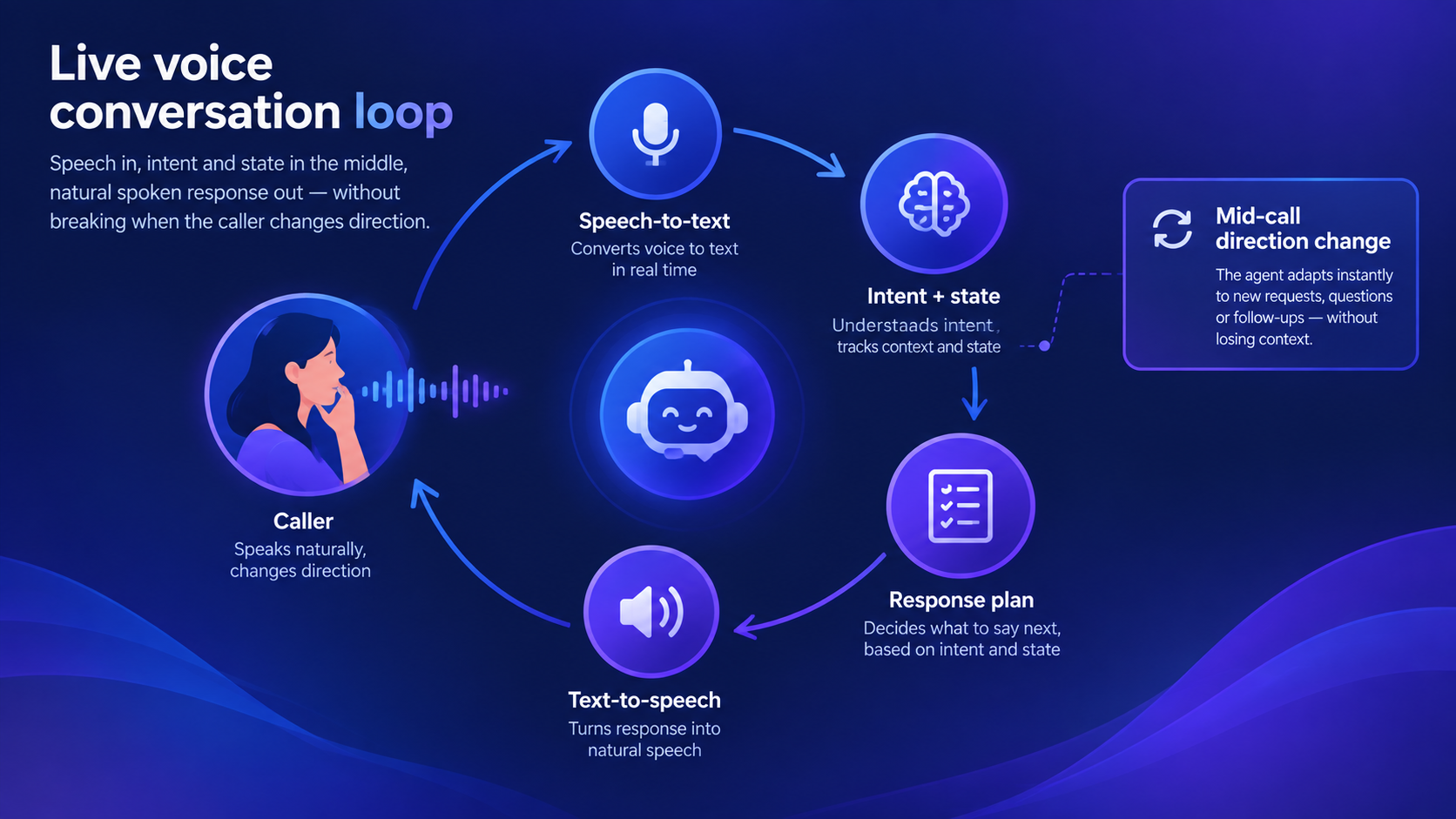
This generative voice agent understands spoken requests, keeps conversational state, and responds in real time. It is designed for live customer interactions such as intake, routing, qualification, and appointment-style calls — without sounding like a rigid IVR.
The same stack can be reused for new call types once speech, state, and handoff are in place.
The challenge
The client needed a voice experience that could handle live conversations without sounding scripted or breaking when callers changed direction mid-request. Menu-style voice flows were not good enough for real intake work.
The solution
We built a generative voice agent with real-time speech understanding, conversational state, and natural spoken responses. Fallback and handoff logic sit in the same flow so a live call can still reach a person when needed.
What we built
How we approached it
Design for interruption
The conversation model assumes the caller will change direction, not complete a form in order.
Keep state, not just the last utterance
What was already collected stays available when the topic shifts.
Sound like a conversation
Responses were tuned for live speech, not chatbot paragraphs read aloud.
Leave a door to a human
Handoff is a designed path, not a crash when the model is unsure.
Examples from the workflow
These are the kinds of moments the system was designed to handle — not hypothetical product slides.
Inbound intake after hours
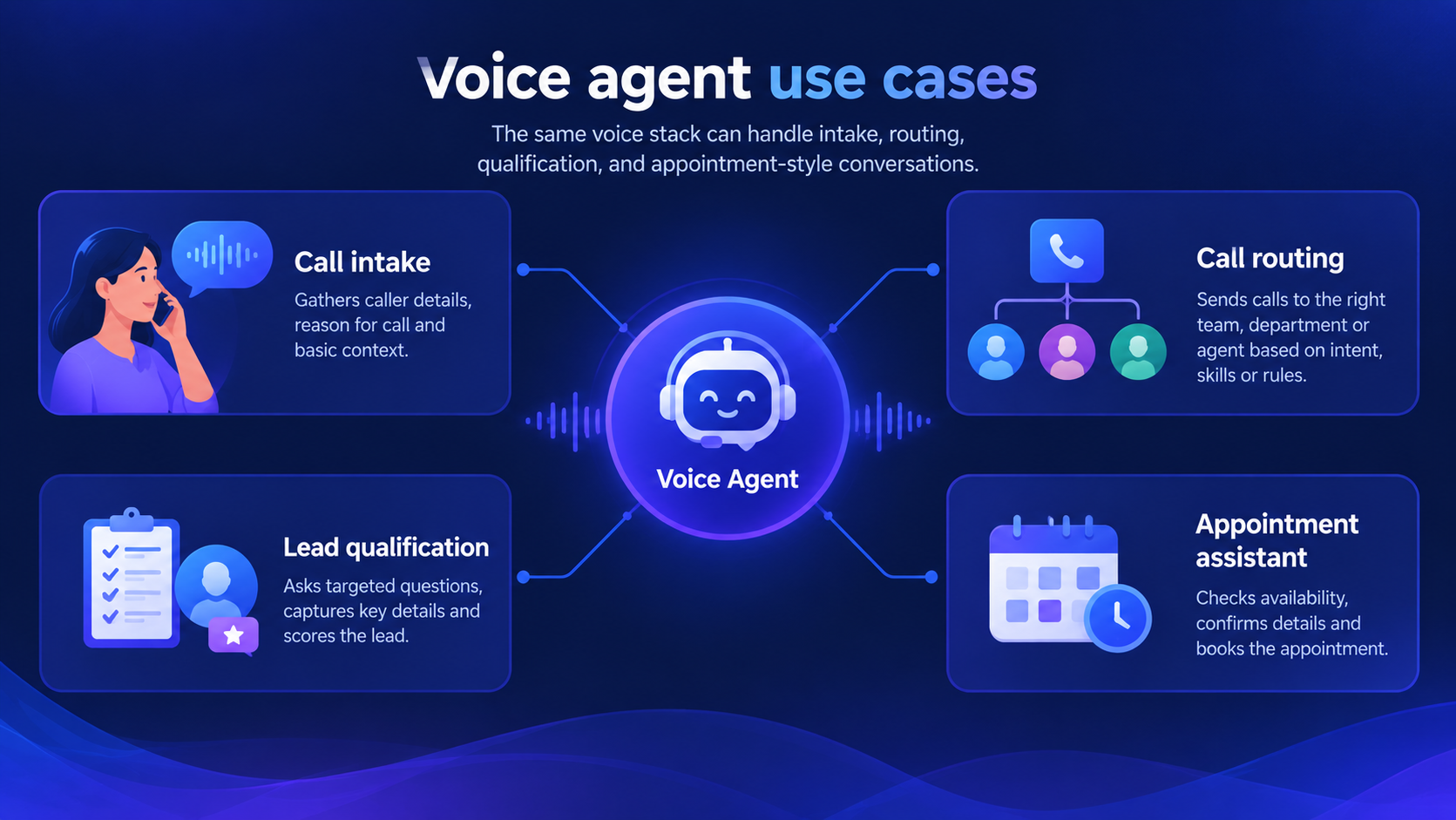
The agent collects the reason for the call and key details, then routes or schedules follow-up without a full overnight desk.
A caller who changes the request mid-sentence
State holds what was already said, so the agent does not restart as if it were a new call.
Lead qualification by phone
The same voice loop can ask structured qualifying questions and pass a brief to sales.
Stack and delivery pieces
Outcomes
Questions this case study usually raises
Is this an IVR or a generative voice agent?
It is a generative voice agent. It understands spoken requests and keeps conversation state instead of forcing callers through a fixed keypad menu. That distinction matters for scoping Lead qualification by phone: we align on users, boundaries, and non-goals during discovery so the build does not drift into unrelated platform work. Deliverables and success metrics follow that definition. If a lighter or different approach fits better, we say so before heavy engineering begins. Related screens and workflows in the case study show how the scope played out in practice.
What happens if the agent cannot complete the request?
Fallback and human handoff are part of the design, so the call can move to a person with context rather than looping. In practice for Lead qualification by phone, those rules are encoded in the workflow with logging so operators can see what occurred and intervene when needed. Edge cases are designed deliberately rather than left to improvisation. After launch, failure patterns feed iteration—knowledge updates, routing changes, or model/evaluation improvements. The operating model is meant to stay visible and supportable for your team.
What call types can it handle?
Intake, routing, qualification, and appointment-style conversations are the patterns this stack was built to support. For engagements like Lead qualification by phone, we confirm fit during discovery against your stack, volume, and compliance constraints rather than assuming every environment matches the case study one-to-one. Integrations, permissions, and review gates are planned explicitly. A pilot usually proves the highest-value path first, then expands once quality and adoption are clear. That keeps delivery practical and measurable.
Can we listen to a demo?
Yes. This case study includes a live audio demo of the voice agent in conversation. The demo is there to make the workflow concrete—how users interact, what the system captures, and what gets handed to a human when needed. It is illustrative of Lead qualification by phone, not a guarantee that your production environment will behave identically without discovery and integration work. After you review it, we typically map the same pattern to your data sources, permissions, and success metrics in a scoped pilot. That sequence keeps evaluation honest before a larger investment.
Voice AI Agents
Our voice AI systems can handle intake, call routing, appointment workflows, and task capture while maintaining a clear conversational flow and consistent brand tone.
View the solutionMore case studies
Browser Agent
An AI workflow agent that navigates web interfaces, completes multi-step browser tasks, and reduces repetitive operations work.
Read case study
Advanced Chatbot
A generative AI chatbot that keeps conversation context, answers across domains, and delivers more human-like support experiences.
Read case study
Multi Agent System
A collaborative AI system where specialized agents plan, execute, and review work together on complex business workflows.
Read case studyNeed a case study like this?
Client names stay confidential. Request fuller details under NDA, or talk through a similar workflow for your team.