AI Interview Automation
We design interview automation systems that can guide candidates through structured interviews, collect responses, and help hiring teams compare candidates more consistently.
Typical impact
Based on similar deployments. Actual results depend on your workflow and data.
When to choose this
- HR teams screening high volume for the same role
- Hiring managers who want consistent questions per JD
- Remote-first companies using async or AI-led first rounds
Is this solution for you?
A quick check before you invest time in a call — who gets the most value, and when to pick something else.
Good fit if you…
- HR teams screening high volume for the same role
- Hiring managers who want consistent questions per JD
- Remote-first companies using async or AI-led first rounds
- Recruiters tired of scattered notes and missing transcripts
Probably not if you…
- Executive hires where every conversation is bespoke from minute one
- Roles with no written JD or scoring rubric
- Companies that cannot store interview recordings compliantly
Before vs after
What actually changes in day-to-day operations — not marketing fluff.
Screening
Today
Recruiter chases notes across email and docs
With this solution
Transcript + score on one scoreboard
Consistency
Today
Each interviewer asks different questions
With this solution
JD-based rounds for every candidate
Comparison
Today
Subjective memory in debrief meetings
With this solution
Side-by-side scores for the role
Speed
Today
Calendar coordination for first screen
With this solution
Async AI round before live panels
How a request moves through the system
Rounds and questions are generated from the JD, then HR can edit them. AI-led interviews and transcripts feed a scoring report and role scoreboard. Recommendations are reviewable; they are not a silent hire.
Role requirements drive round structure and questions
Interview link or scheduler sent with instructions
Structured questions, follow-ups, transcript capture
Rubric applied; scores appear on role scoreboard
Recruiter edits questions or overrides recommendation
Hiring manager advances or rejects with full record
Real scenarios
Concrete situations this solution is built to handle — not generic feature bullets.
Screening a large slate for one role
AI-led interviews and structured scores let HR compare ten candidates on the same criteria before panel time is spent.
A hiring manager who missed the live round
Transcript and scoring report are available on the scoreboard, so review is not 'ask someone what they thought.'
HR adjusting questions mid-search
If the JD shifts, custom questions can be edited without throwing away the rest of the round structure.
What we build
- JD-based interview flows
- Question routing and scoring
- Transcript and note capture
- Recruiter review dashboards
- Role scoreboards for candidate comparison
- Human review of AI recommendations
Outcomes you can expect
- Faster screening with structured evaluation
- Shared scoreboard per role
- Transcripts instead of lost notes
- HR control over questions and final hire
Connects with
Common use cases
- · HR screening automation
- · Candidate interview flows
- · Role-based scorecards
- · Hiring operations dashboards
How we typically deliver
Phases and outputs so you know what happens week by week. Timelines adjust to your scope.
Week 1–2
Scoring rubric and JD template for one role
You get: Interview workflow blueprint
Week 3–4
AI interview flow + transcript storage
You get: Pilot role live
Week 4–5
Scoreboard and HR override UI
You get: Recruiter training session
Week 5+
Roll to additional roles and refine questions
You get: Hiring ops dashboard
Common questions
Does the AI make the hiring decision?
No. The system runs structured interviews, captures transcripts, and produces scores and recommendations so HR and hiring managers can compare candidates consistently. People still review evidence and make the hiring decision. That separation matters for fairness, accountability, and trust with candidates. Automation removes repetitive early-round scheduling and inconsistent questioning; it does not outsource final judgment. We design reporting so a score is backed by what happened in the interview, not a black-box verdict.
How are interview rounds created?
Rounds are configured from the job description and role requirements, then HR can edit custom questions so the process stays aligned with the team’s bar. Structured scoring rubrics keep comparisons consistent across candidates. You control which rounds are automated versus human-led. Changes to the JD can update future interview kits without rewriting the whole process. During setup we align on competencies, disqualifiers, and what must never be asked. The result is a repeatable interview kit, not a one-off script per recruiter.
What is captured from interviews?
Transcripts and structured scores are captured so ratings are backed by evidence from the conversation, not only an interviewer’s memory hours later. Hiring teams can review what was asked, how the candidate responded, and how scores map to competencies. Access controls determine who can see recordings or transcripts based on your policy. That auditability helps calibration across interviewers and reduces “gut feel only” debates. We configure retention and privacy settings to match your HR and legal requirements during deployment.
Who is this for?
It is for companies that want consistent, JD-based hiring—especially teams screening many candidates and comparing them on a shared scoreboard. High-volume recruiting, distributed hiring managers, and roles with clear competency frameworks see the most value. It is less useful when every hire is a unique executive search with no shared rubric. During discovery we confirm volume, interview stages, and fairness requirements. The outcome is faster, more consistent early-round signal for humans to decide on—not automated hiring.
Shipped in production
Related case study
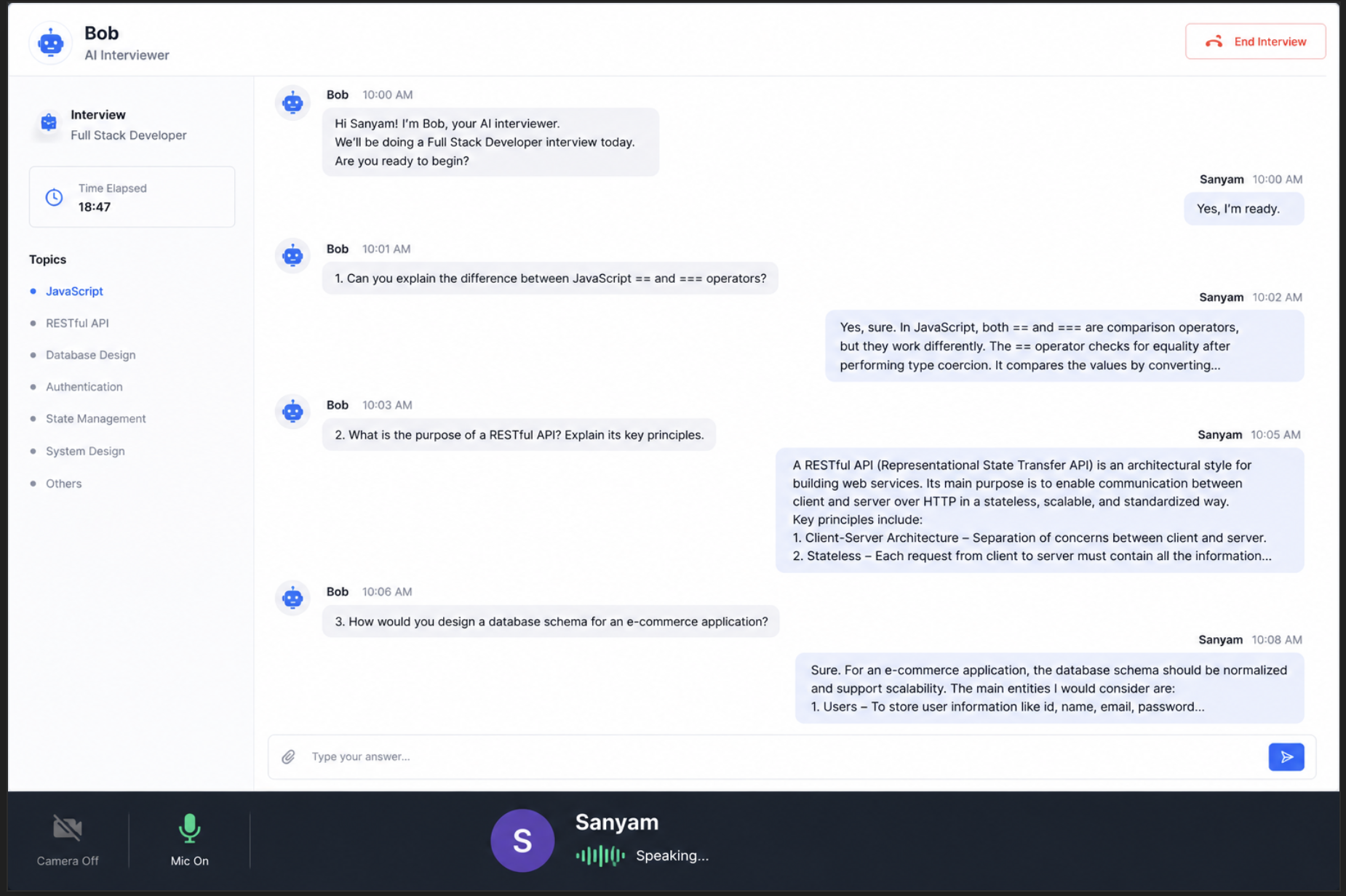
AI Interview Management Platform
An HR platform for JD-based hiring, AI-led interviews, Google Meet transcript capture, scoring reports, and role scoreboards.
Read the full case studyOther solutions
Reduce support load
Customer Support Automation
Coordinate specialist agents
AI Multi Agents
Natural voice interactions
Voice AI Agents
Want this mapped to your workflow?
We will walk through your tools, volume, and escalation rules — and tell you honestly if this is the right fit.
Book a consultation