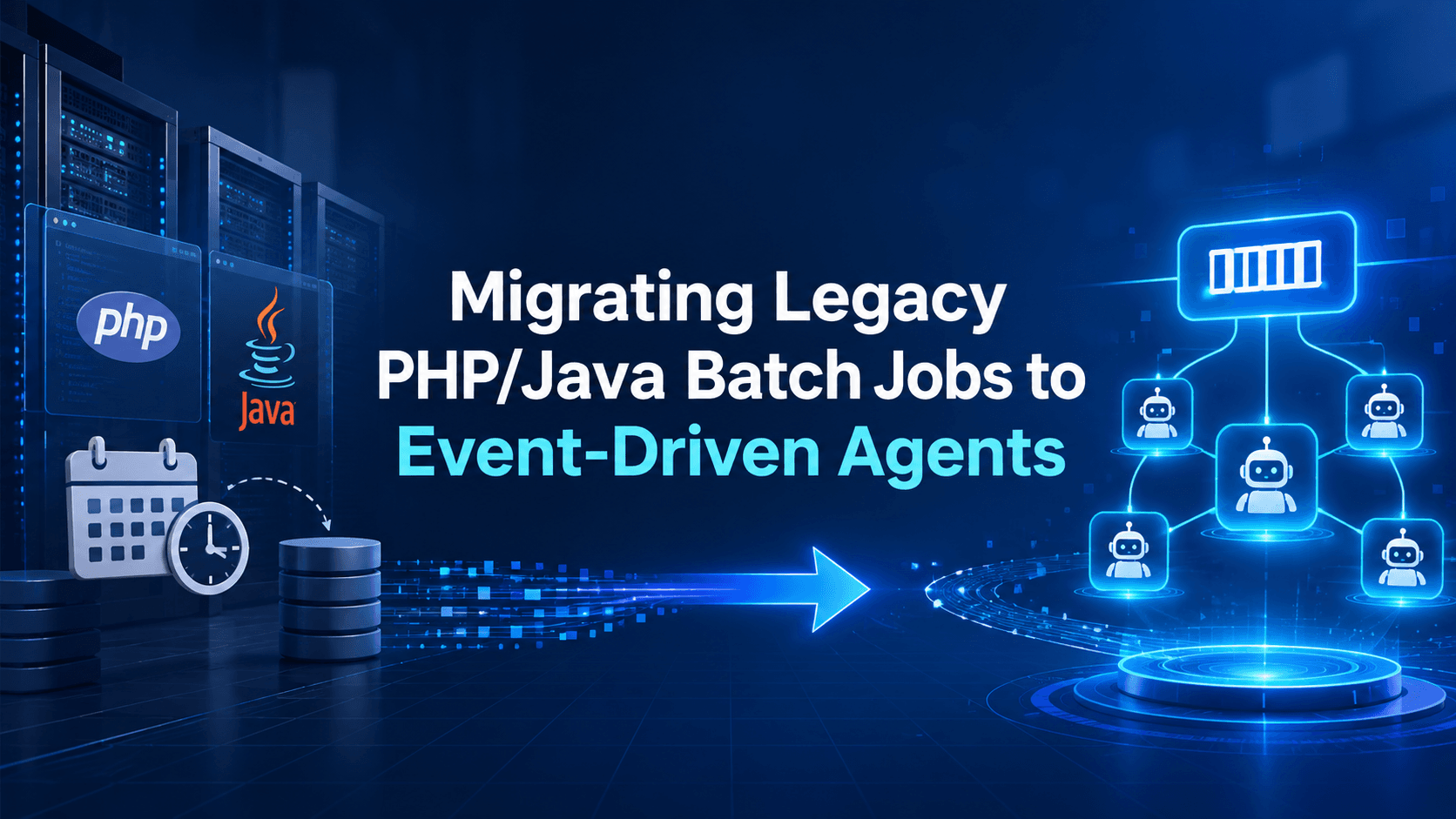
The Latency Trap: Why Cron Jobs Are Failing Modern Users
Modern software stacks demand real-time responsiveness, yet many organizations still rely on fixed-interval cron jobs to process critical data. This legacy approach creates a significant latency trap, where end-users experience stale information because data is only updated when the scheduled batch runs. For applications requiring immediate feedback, this delay translates directly into poor user experience and lost engagement.
Technical Debt in PHP and Java Ecosystems
Monolithic batch scripts written in PHP or Java often suffer from rigid architectures that are difficult to scale or modify. These scripts typically handle multiple concerns—data fetching, transformation, and storage—within a single execution context. When one step fails, the entire job halts, requiring manual intervention or a full re-run. This lack of granularity increases operational overhead and makes it challenging to integrate new data sources without refactoring the entire pipeline.
- Data Staleness: Users see outdated records until the next cron cycle completes.
- Resource Spikes: Batch jobs create unpredictable load peaks, straining infrastructure.
- Debugging Complexity: Monolithic scripts make it hard to isolate and fix specific processing errors.
As user expectations shift toward instant updates, the operational pain points of legacy batch processing become increasingly untenable. Transitioning to event-driven architectures allows systems to react to changes as they happen, rather than waiting for the next scheduled interval. This shift reduces latency and improves system resilience by breaking down monolithic processes into smaller, manageable units. For teams looking to modernize their infrastructure, exploring how AI multi agents can automate complex workflows offers a practical path forward. By replacing rigid cron schedules with dynamic event triggers, organizations can achieve the real-time performance that modern users expect.
Defining the Shift: From Scheduled Batches to Reactive Agents
Traditional batch processing relies on fixed schedules, creating rigid boundaries between data ingestion and execution. In contrast, event-driven architecture decouples these layers, allowing systems to react immediately as data arrives. This shift eliminates the waiting periods inherent in cron-based jobs, enabling real-time responsiveness that modern applications demand.
The Role of AI Agents in Dynamic Execution
While event-driven systems handle the flow of data, AI agents provide the intelligence to interpret it. These agents do not simply execute static scripts; they analyze context, assess urgency, and determine the optimal course of action. By integrating cognitive capabilities into the event stream, organizations can move beyond rigid automation toward adaptive problem-solving.
- Decoupled Ingestion: Data enters the system independently of processing logic, preventing bottlenecks during peak loads.
- Context-Aware Logic: Agents evaluate each event against current business rules and historical patterns to make informed decisions.
- Dynamic Task Execution: Workflows adapt in real-time, adjusting steps based on intermediate results rather than following a pre-defined linear path.
This architectural distinction is critical for teams moving away from monolithic legacy systems. Instead of waiting for the next scheduled run, your infrastructure can process transactions, update records, and trigger notifications the moment an event occurs. For a deeper look at how these components interact, consider exploring our AI Multi Agents solution, which details how multiple agents collaborate to handle complex, multi-step workflows efficiently.
Decomposing the Monolith: A Step-by-Step Migration Framework
Breaking down legacy PHP and Java batch jobs requires a disciplined approach to isolate business logic from execution timing. The first step is auditing existing scripts to identify atomic tasks. These are discrete units of work, such as data validation, API calls, or database updates, that can be executed independently. By mapping these tasks, you create a clear inventory of what needs to be migrated, ensuring no critical logic is lost during the transition.
Implementing the Event Bus for Reactive Triggers
Once atomic tasks are identified, the next phase involves replacing scheduled cron triggers with an event bus architecture. This infrastructure listens for specific signals, such as a new record insertion or a webhook payload, and publishes events to the system. Each event is then routed to a specialized AI agent designed to handle that specific task. This setup allows for immediate processing rather than waiting for the next scheduled batch window.
- Define event schemas for each atomic task to ensure consistent data payloads.
- Deploy lightweight agents that subscribe to specific event topics.
- Implement retry logic and dead-letter queues to handle transient failures gracefully.
This modular approach not only reduces latency but also improves system resilience. If one agent fails, it does not block the entire batch process. For organizations looking to scale this architecture, exploring a AI Multi Agents strategy can further enhance how complex workflows are split and executed. This framework provides a practical roadmap for transforming rigid batch processes into flexible, real-time systems.
Operational Gains: Latency, Maintainability, and Scalability
Transitioning from legacy PHP or Java batch scripts to event-driven agents fundamentally alters your system's operational profile. The most immediate benefit is the elimination of the "latency trap." Instead of waiting for the next scheduled cron execution, your infrastructure reacts to data changes instantly. This shift transforms user-facing applications from sluggish, periodic updates into responsive, real-time experiences.
Quantifying the Performance Shift
The difference between scheduled and reactive processing is stark. Below is a comparison of typical operational metrics when migrating a standard data synchronization task:
| Metric | Legacy Batch (Cron) | Event-Driven Agent |
|---|---|---|
| Avg. Latency | 30–60 minutes | < 200 milliseconds |
| Resource Utilization | Spiky (peak during batch) | Steady (on-demand) |
| Failure Recovery | Manual re-run | Automatic retry |
Beyond speed, maintainability improves significantly. Monolithic batch jobs often contain tangled logic for validation, transformation, and persistence. By decomposing these into specialized agents, you create modular components that can be tested and updated independently. This modularity allows you to scale specific workflows without over-provisioning the entire system. For teams looking to implement this, understanding the architecture of a AI Multi Agents system is essential for ensuring that each component handles its specific domain of responsibility effectively.
- Independent Scaling: Spin up more instances of a specific agent during peak loads without affecting other processes.
- Isolated Failures: A bug in one agent does not crash the entire pipeline, improving overall system resilience.
- Clear Ownership: Developers can own specific agent modules, reducing merge conflicts and code complexity.
These gains translate directly into lower infrastructure costs and a more agile development cycle, making the migration not just a technical upgrade, but a strategic business advantage.
Real-World Scenarios: E-Commerce and Financial Data Pipelines
Abstract frameworks gain clarity through concrete implementation. Consider a mid-sized e-commerce platform migrating from nightly PHP batch scripts to reactive agents. When inventory levels drop below a threshold, an event fires. Instead of waiting for the next scheduled run, a pricing agent immediately recalculates dynamic discounts and updates the storefront. This shift eliminates stale pricing errors and improves conversion rates by ensuring customers always see accurate, competitive offers.
Financial Data Pipelines and Fraud Detection
In the financial sector, legacy Java batch jobs often process transaction logs in hourly windows. This delay is unacceptable for fraud prevention. By refactoring these pipelines into event-driven streams, each transaction event triggers a specialized fraud detection agent. These agents analyze behavioral patterns in real-time, flagging anomalies within milliseconds. This approach not only reduces financial loss but also enhances customer trust through immediate, transparent security responses.
| Use Case | Legacy Batch Limitation | Event-Driven Agent Benefit |
|---|---|---|
| E-Commerce Pricing | Stale prices, delayed stock updates | Instant dynamic pricing, accurate inventory |
| Financial Fraud | Hourly detection windows, high risk | Real-time anomaly flagging, lower loss |
These examples demonstrate how decomposing monolithic jobs into specialized agents creates measurable operational value. For teams looking to implement similar architectures, exploring a AI multi-agent system can provide foundational insights into task distribution and coordination. Additionally, integrating a browser agent can automate the downstream verification tasks that often follow these event-driven workflows, ensuring end-to-end automation without human intervention.
Navigating Complexity: Challenges and Best Practices
Transitioning from monolithic batch jobs to event-driven AI agents introduces significant architectural complexity. The primary hurdle is managing state in a distributed environment where events may arrive out of order or duplicate. Without robust safeguards, your agents risk processing stale data or executing redundant actions, leading to data integrity issues.
Ensuring Reliability Through Idempotency and Ordering
To mitigate these risks, every agent action must be designed to be idempotent. This ensures that retrying a failed event does not produce side effects. Additionally, implementing strict event ordering guarantees that dependent tasks execute in the correct sequence. For failure recovery, use dead-letter queues to isolate problematic events for manual inspection or automated retry logic.
| Challenge | Best Practice | Outcome |
|---|---|---|
| Event Duplication | Idempotent handlers | No duplicate side effects |
| Out-of-Order Delivery | Sequence tracking | Correct execution flow |
| Agent Failure | Dead-letter queues | Graceful degradation |
Monitoring is equally critical. You must track not just system health, but the semantic flow of events. Use distributed tracing to follow a single request across multiple agents. This visibility allows you to pinpoint bottlenecks and debug complex interaction patterns. By combining rigorous state management with deep observability, you can build agent systems that are both resilient and performant. Explore how CogniCrew AI Solutions can help you architect your transition to event-driven agent systems.
Why CogniCrew AI Solutions for Your Modernization Journey
Transitioning from rigid batch processing to dynamic, event-driven architectures requires more than just new code; it demands a strategic partner who understands the nuances of legacy integration. CogniCrew AI Solutions specializes in bridging the gap between monolithic PHP and Java systems and modern, responsive agent frameworks. Our approach ensures that your existing infrastructure is not discarded but intelligently decomposed and re-orchestrated for real-time performance.
Proven Expertise in Multi-Agent Orchestration
Our team has extensive experience designing systems where specialized agents collaborate to handle complex business logic. We do not view migration as a simple lift-and-shift operation. Instead, we engineer tailored solutions that leverage the strengths of AI multi agents to split complex workflows into manageable, reactive steps. This methodology reduces latency and improves maintainability by distributing cognitive load across dedicated agents rather than overloading a single batch process.
- Legacy Integration: Seamless connection between existing PHP/Java codebases and new event streams.
- Agent Design: Custom development of planning, execution, and review agents for specific business needs.
- Operational Oversight: Continuous monitoring and optimization of agent interactions to ensure reliability.
For organizations looking to automate repetitive operational tasks alongside their core business logic, our Browser Agent case study illustrates how autonomous agents can navigate web interfaces to complete multi-step tasks without human intervention. This capability is particularly valuable when legacy systems lack modern APIs, allowing agents to interact with user interfaces directly. By partnering with CogniCrew AI Solutions, you gain access to a proven framework for executing this architectural shift, ensuring your systems remain scalable and responsive as your business evolves.
Key Takeaways and Strategic FAQs for Event-Driven Migration
Transitioning legacy PHP and Java batch jobs to event-driven AI agents fundamentally alters how your systems process data and respond to user actions. The primary benefit is the elimination of polling latency, replacing scheduled waits with immediate, reactive processing. This shift reduces infrastructure waste by only consuming resources when events occur, rather than running idle loops. It also improves maintainability by decoupling business logic from rigid scheduling constraints, allowing teams to update individual agents without disrupting the entire pipeline. For organizations handling high-volume transactions, this architecture provides linear scalability that cron-based systems cannot match. The move from monolithic scripts to specialized agents also enhances fault isolation, ensuring that a failure in one component does not cascade across the entire batch window.
Ready to transform your legacy infrastructure? Explore how CogniCrew AI Solutions can help you architect your transition to event-driven agent systems.
What are the primary security risks when migrating batch jobs to AI agents?
The main security risk involves expanded attack surfaces due to increased inter-agent communication and external API integrations. You must implement strict identity verification for each agent to prevent unauthorized data access. Network segmentation is critical to isolate sensitive data pipelines from general-purpose agents. Additionally, you need robust logging and monitoring to detect anomalous behavior in real-time. Without these controls, the reactive nature of event-driven systems can amplify vulnerabilities if compromised. Focus on least-privilege access models and regular security audits to mitigate these risks effectively.
How much does it cost to convert legacy PHP and Java jobs to event-driven agents?
Costs vary significantly based on the complexity of existing logic and the scale of your infrastructure. Initial expenses include refactoring code into modular agents and setting up event brokers like Kafka or RabbitMQ. You will also incur costs for cloud-native agent hosting and API usage fees. However, long-term savings often emerge from reduced compute time, as agents only run when triggered. Organizations typically see a return on investment within six to twelve months through improved operational efficiency. Budget for a phased rollout to manage initial capital expenditure more predictably.
What technical prerequisites are required before starting the migration?
You need a stable event streaming platform capable of handling your peak throughput reliably. Your team must possess proficiency in asynchronous programming patterns and message queue management. Legacy code should be refactored into stateless functions to ensure compatibility with event-driven architectures. Clear data contracts between agents are essential to prevent integration errors during the transition. Additionally, you require observability tools to track event flow and agent performance. Without these foundational elements, the migration will face significant technical debt and operational instability.
How long does it take to fully migrate a large-scale batch system?
A full migration typically takes between three and nine months depending on system complexity. The timeline includes discovery, refactoring, parallel running, and final cutover phases. Simpler scripts can be converted in weeks, while deeply coupled enterprise systems require longer. Parallel running is crucial to validate accuracy before decommissioning legacy jobs. You should allocate extra time for testing edge cases and performance tuning. A phased approach allows your team to gain confidence and adjust strategies without halting business operations.
Related CogniCrew AI Solutions resources
- Multi Agent System — A collaborative AI system where specialized agents plan, execute, and review work together on complex business workflows
- Browser AI Agents — Let AI agents operate web interfaces, complete repetitive browser tasks, and move multi-step workflows forward automatic